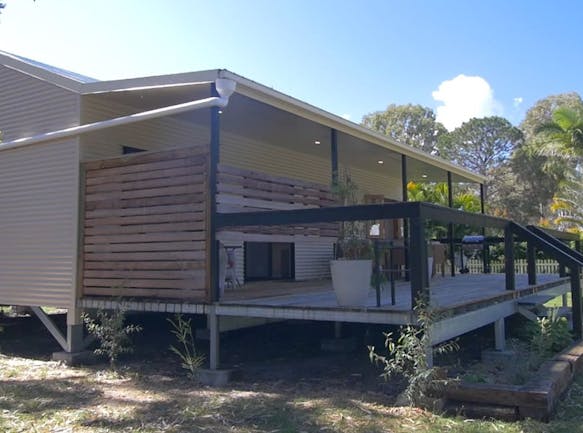
If you’re planning a new home, you’ve probably come across both kit homes and prefabricated (prefab) homes. While they might seem similar, how they are delivered and built can determine which is a better fit for your project. Here’s a simple overview of key differences.
Kit Homes Explained
A Wide Span Kit Home is supplied as a complete frame and cladding package, with all materials pre-cut and ready for assembly (some cutting and drilling may still be required). It is not a complete home, as fixtures, fittings, and internal finishes are not included. Kit homes are designed to be assembled on site by a registered builder or owner-builder. Everything arrives with detailed plans and engineering documents.
Kit homes appeal to those who prefer to be involved throughout the process, whether that means choosing their own builder or taking part in the project management themselves. They are supplied in fixed designs, with flexibility in finishes, fit-out, doors, windows, and other appointments to personalise the final result.
Prefab Homes Explained
A prefab home, also called a modular home, is built in large sections or complete modules within a factory, then transported to the site for installation. Since most of the build is completed off-site, the on-site phase is usually much shorter, with most of the overall timeframe occurring during factory construction.
This type of home can be a good option for those who prefer less on-site construction. Much of the work takes place in a controlled factory environment, helping to reduce weather-related delays. Once complete, the modules are transported to the site for final assembly.
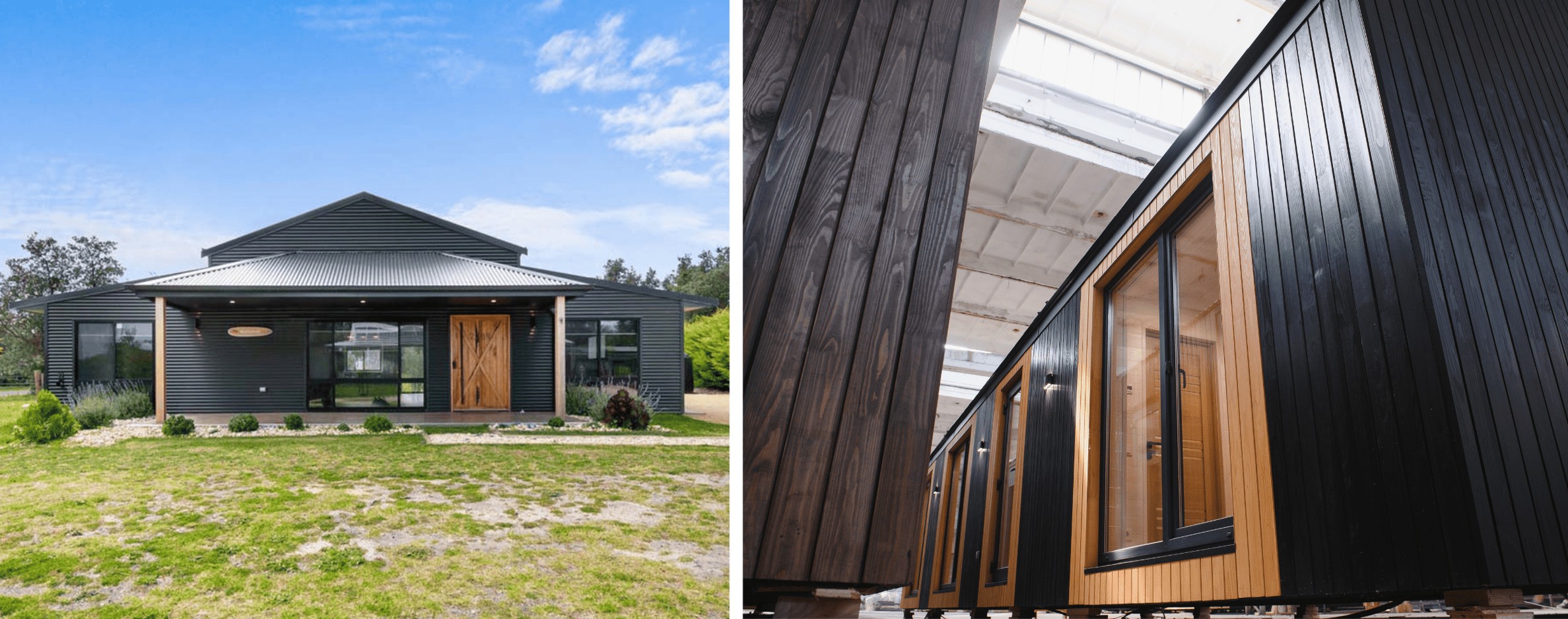
Kit home on left hand side, prefab home on right hand side.
Side-by-Side Comparison of Kit Homes and Prefab Homes
While both options provide efficient ways to own a new home, there are some clear distinctions when it comes to cost, construction, and flexibility.
Feature | Wide Span Homes Kit Home | Prefab Home |
How it is supplied | Delivered as a complete kit of pre-cut BlueScope Steel components, ready to be assembled by a registered builder on site. | Built as large sections or full modules in a factory, then transported to site for final installation. |
Cost per square metre | Lower overall cost as you are paying mainly for materials and engineering, not full construction. Controlling the cost of other inputs is where the savings occur. For instance, The Cabin 50 (50 m²) kit starts from $27,800 (approximately $556 per m²). | Prices vary depending on the supplier, with the national averages of $2,500 to $3,000 per m². |
Construction process | Materials are supplied for on-site assembly by a registered builder or owner-builder, allowing flexibility in scheduling and project management. | Modules are assembled off-site in a factory setting and delivered almost complete, which can reduce on-site construction time but may limit access to certain locations. |
Durability | Manufactured from Australian BlueScope Steel with up to a 20-year warranty. Frames are termite-resistant and designed to withstand local wind conditions, including cyclonic regions. | Durability depends on the manufacturer and materials used, which may include steel, timber, or composite panels. |
Council approvals | Wide Span Homes offer a Council Approved Guarantee and are engineered to meet Australia’s strict Class 1 building codes and standards. Clients typically need to compile additional drawings and reports to meet council approval, including energy efficiency assessments, BAL reports, and other site-specific documentation. | Compliance is managed by the manufacturer and may require additional certification depending on local regulations. |
Choosing What’s Right for You
Both kit and prefab homes are efficient ways to create a new home. Kit homes are usually more affordable, while prefab homes are more time-efficient.
Before deciding, it’s worth looking at additional factors such as your location, budget, and how involved you’d like to be in the project. Both options can deliver a quality, compliant home when designed and engineered by reputable suppliers.